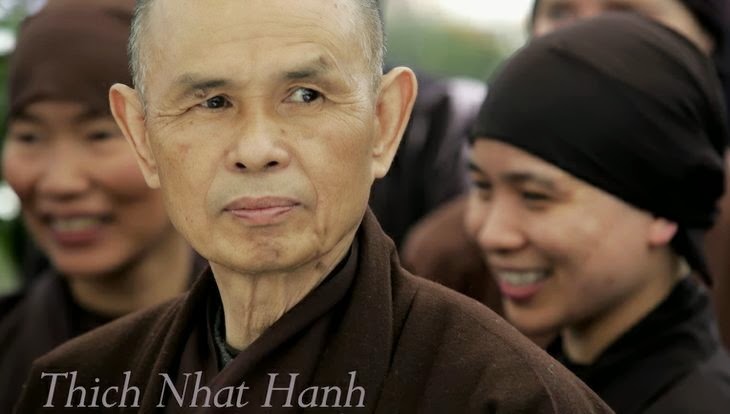
Showing posts with label Plum Village. Show all posts

Sunday, 2 March 2014

The Beauty Of Spring Blocks My Way

Spring comes slowly and quietly
to allow Winter to withdraw
slowly and quietly.
The color of the mountain this afternoon
is tinged with nostalgia.
The terrible war flower
has left her footprints-
countless petals of separation and death
in white and violet.
Very tenderly, the wound opens itself in the depths of my heart.
Its color is the color of blood,
its nature the nature of separation.

The beauty of Spring blocks my way.
How could I find another path up the mountain?

I suffer so. My soul is frozen.
My heart vibrates like the fragile string of a lute
left out in a stormy night.
Yes, it is really there. Spring has really come.
But the mourning is heard
clearly, unmistakably,
in the wonderful sounds of the birds.
The morning mist is already born.
The breeze of Spring in its song
expresses both my love and my despair.
The cosmos is so indifferent. Why?
To the harbor, I came alone,
and now I leave alone.

There are so many paths leading to the homeland.
They all talk to me in silence. I invoke the Absolute.
Spring has come
to every corner of the ten directions.
Its song, alas, is only the song
of departure.

1951. This was written less than twelve hours after I fell in love
with a nun. It happened at the Vien Giac Temple on New Year's
Eve in the beautiful village of Cau Dat in the highlands. She was
twenty. Both of us realized that we wanted to continue being a
monk and a nun. So we decided to depart from each other. This
was not easy. I was lucky to having a loving and understanding
sangha with me at that time that made it possible. Forty-one years
later, I told this story in a twenty-one day retreat at Plum Village
in English, on the theme of Vipassana meditation in the Mahayana
tradition.

~Thich Nhat Hanh

Tuesday, 18 February 2014

Vijñaptimatra Buddhism For Dummies

What is most precious in this world? What is it that truly makes you happy? If you think it is love, you are already a Vijñaptimatrin. Buddha's love is unconditional. It has no barriers, no limitations. This selfless love which is unconditional, without any limitations, devoid of any expectations is true love. All you need is love. This love ends all sufferings. Happiness is experiencing love.

Vijñaptimatrins learn to love like this, so they can be happy and they can bring joy to others. Vijñaptimatra Buddhism is the path of love, the path of Maitreya - the Buddha of love.

Like you go to a medical school to become a doctor. Here you become a Buddha. Until you have become a doctor, you are a student. Here, you are a Bodhisattva until you become a Buddha. Much like school, here too we have grades - Bodhisattva bhoomis.

Vijñaptimatra (pronounced vigyapti-maatr) means manifestation-only. It means that there is no birth, no death. We are not created or destroyed. We manifest. Everything around us is a manifestation. A rose manifests when the required conditions are present. The seed, water, earth etc. It is not born and it never dies. When conditions are right, we manifest. A manifestation is an appearance of signs. It is not birth. The absence of conditions supporting manifestation is not death.

The Geography Of Samsara and Nirvana

According to Vijñaptimatra Buddhism, there are two minds and three natures of reality. The deluded mind is the cause of all sufferings - the first link of the twelve links in the cycle of Interdependent Co-arising. This cycle is know as the cycle of birth and death and the nature of reality perceived under the influence of the deluded mind is known as parikalpit svabhav - Samsara. In Samsara there is parting, dissatisfaction and misunderstanding.

The other mind, the true mind, creates a world of suchness. There is no birth and death. No coming, no going. No after, no before. No one, no many. No existence, no non existence. It is complete, lacking nothing. This nature of reality is known as nishpanna svabhav - Nirvana. In Nirvana, there is no parting. There is satisfaction and understanding.

Deluded mind creates suffering. True mind creates happiness. The link between the two is paratantra svabhav - interdependence. So in order to reach the shores of nishpanna svabhav, we must go through the world of interdependence. We must constantly learn to see everything in the light of interdependence. We develop our mindfulness to enable us to constantly see the interdependent nature of things.

The Science Of Samsara and Nirvana

According to my teacher, Thich Nhat Hanh, "The Three Dharma Seals of impermanence, nonself, and nirvana are the keys to understanding the Manifestation Only teachings. The first key is impermanence, and it is used to open the door of reality concerning time. Nonself, the second key, is used to open the door of reality concerning space. They are spoken of as different but in truth they are one. Time and space are one. One cannot be without the other. The third key, nirvana, is the fulfilled nature, the reality of no birth, no death; no coming, no going; no one, no many; no existing, no not-existing. This is the world of Interdependent Co-Arising, where nothing exists as a separate, permanent entity. Impermanence and nonself go together with the nature of interbeing.

To touch nirvana, to see the interdependent nature of reality, we have to touch impermanence and nonself. The nature of imaginary construction goes together with our deluded beliefs in permanence and a separately existing self. We see the world around us as permanent and consisting of separate self-existing entities. That is why when we begin the practice we need to use the two keys of impermanence and nonself to shine light on the Interdependent Co-Arising nature of all things."

Our Toolkit

In the words of my perfect teacher, Thich Nhat Hanh, "The Buddha taught that there are Five Powers. First is the power of faith. We need to have faith in the possibility of touching nirvana, of awakening to suchness. This is not blind faith, it is based on our understanding, insight, and experience. Faith leads to energy, the second power. Without faith and confidence, we easily get tired. To have the energy to look deeply into things, we need to have confidence in our capacity for awakening, and faith in the awakened understanding of the Buddha. We transform our energy into mindfulness, the third power. Where there is mindfulness, there is concentration, the fourth power.

When we live in mindfulness, everything takes place in the concentration of looking deeply. We can see the interdependent co-arising nature of things within and around us. When our concentration is weak, we might be able to see their interdependent nature for a short time, but we soon fall back into seeing things as permanent and having a separate self. But with strong and steady concentration, we can continue to see the nature of interbeing of things within and around us. When our concentration is great, it leads to the fifth power, understanding. With understanding we don’t spend time dreaming of the future or dwelling in the past. We wake up to our true mind. With one mindful step, we enter the Realm of Suchness. Understanding, in turn, strengthens our faith. The Five Powers help each other."

Our Curriculum

Samadhi of Emptiness - Emptiness is interdependent co-arising, impermanence and nonself. We are empty of a separate, independent self. A rose is not separate from water, earth, sunlight etc. We practice nourishing this insight all day long.

If we think that we or others are separate from each other then we create conditions for selfishness and expectations. We must free others, not enslave them. True love is devoid of selfishness and expectations. True love is empty.

Text that I follow - Heart Sutra (commentary by Thich Nhat Hanh).

Samadhi of Signlessness - A rose is made of non-rose elements. Looking at a rose we see the elements that produce a rose. Learning to see in this manner, we learn to go beyond time and space. We learn to not get caught in the four signs - self, person, living-being and lifespan.

If we think that we or others are persons or things, or have a lifespan, we will experience parting. In true love there is no parting. True love is signless.

Text that I follow - Diamond Sutra (commentary by Thich Nhat Hanh).

Samadhi of Aimlessness - Aimlessness is learning to live in the here and now. We practice mindful breathing, mindful eating, walking etc.

If we are not present, we cannot show our love. If the mind is elsewhere then we miss the present moment. What is more important that to love and be loved? There is nothing to attain. Nothing to become. True love is aimless.

Texts that I follow - Discourses on the full Awareness of Breathing (Majjhima Nikaya Sutra # 118, and Samyukta Agama Sutra # 803, 810 and 815 commentaries by Thich Nhat Hanh) and Fourteen Mindfulness Trainings as taught by Thich Nhat Hanh.

Our Mantra

No coming, no going,
No after, no before.
I hold you close to me,
I release you to be so free.
Because I am in you,
And you are in me.

(The author, Saurabh Singh, is a student of the Buddhist monk Thich Nhat Hanh. He is a Foreclosure Prevention Activist and a vegan. He is also a member of People for Ethical Treatment of Animals(India), Consumer Advocates in American Real Estate, UNITES Professionals and supports charitable causes and crowdfunding.)

Monday, 17 February 2014

The River and the Clouds - Thich Nhat Hanh

Once upon a time there was a beautiful river finding her way among the hills, forests, and meadows. She began by being a joyful stream of water, a spring always dancing and singing as she ran down from the top of the mountain. She was very young at the time, and as she came to the lowland she slowed down. She was thinking about going to the ocean. As she grew up, she learned to look beautiful, winding gracefully among the hills and meadows.

One day she noticed the clouds within herself. Clouds of all sorts of colors and forms. She did nothing during these days but chase after clouds. She wanted to possess a cloud, to have one for herself. But clouds float and travel in the sky, and they are always changing their form. Sometimes they look like an overcoat, sometimes like a horse. Because of the nature of impermanence within the clouds, the river suffered very much. Her pleasure, her joy had become just chasing after clouds, one after another, but despair, anger,and hatred became her life.

Then one day a strong wind came and blew away all the clouds in the sky. The sky became completely empty. Our river thought that life was not worth living, for there were no longer any clouds to chase after. She wanted to die. "If there are no clouds, why should I be alive?" But how can a river take her own life?

That night the river had the opportunity to go back to herself for the first time. She had been running for so long after something outside of herself that she had never seen herself. That night was the first opportunity for her to hear her own crying, the sounds of water crashing against the banks of the river. Because she was able to listen to her own voice, she discovered something quite important.

She realized that what she had been looking for was already in herself. She found out that clouds are nothing but water. Clouds are born from water and will return to water. And she found out she herself was also water.

The next morning when the sun was in the sky, she discovered something beautiful. She saw the blue sky for the first time. She had never noticed it before. She had only been interested in clouds, and she had missed seeing the sky, which is the home of all the clouds. Clouds are impermanent, but the sky is stable. She realized that the immense sky had been within her heart since the very beginning. This great insight brought her peace and happiness. As she saw the vast wonderful blue sky, she knew that her peace and stability would never be lost again.

That afternoon the clouds returned, but this time she did not want to possess any of them. She could see the beauty of each cloud, and she was able to welcome all of them. When a cloud came by, she would greet him or her with loving-kindness. When the cloud wanted to go away, she would wave to him or her happily and with loving kindness. She realized that all clouds are her. She didn't have to choose between the clouds and herself. Peace and harmony existed between her and the clouds.

That evening something wonderful happened. When she opened her heart completely to the evening sky she received the image of the full moon - beautiful, round, like a jewel within herself. She had never imagined that she could receive such a beautiful image. There is a very beautiful poem in Chinese: "The fresh and beautiful moon is traveling in the utmost empty sky. When the mind-rivers of living beings are free, that image of the beautiful moon will reflect in each of us."

This was the mind of the river at that moment. She received the image of that beautiful moon within her heart, and water, clouds, and moon took each other's hands and practiced walking meditation slowly, slowly to the ocean.

There is nothing to chase after. We can go back to ourselves, enjoy our breathing, our smiling, ourselves, and our beautiful environment.

Sunday, 16 February 2014

Veganism and Buddhism

Buddhism is learning to do the right things - to practice and promote right mindfulness, right view, right thinking, right action, right speech, right concentration, right diligence, right livelihood. It is the path to happiness. The foundation of happiness is freedom, so it is also the path to liberation. It is likely then that one who wants to be free respects, practices and promotes freedom.

Veganism is the practice of respecting the right of all sentient beings to be free. Vegans practice living in a manner that they do not end up using other sentient beings as resources like food or slaves and avoid exploiting their body and mind.

Thus, vegans do not consume milk or meat or butter or cheese or eggs. They do not use leather or animal-tested cosmetics or anything that comes from an animal or that might have jeopardized an animal's welfare, health or freedom. They practice living in this manner to the extent possible. The Buddha of our times, Thich Nhat Hanh, is a vegan.

In Buddhism there are many precepts. These are vows or declaration of our commitment to practice certain wholesome actions and avoid unwholesome actions. One of such precepts is not to harm other sentient beings. Killing and eating them may rightfully be construed as causing harm to them. It is also not mindful consumption - a violation of another precept. Similarly, not taking what is not rightfully ours is another precept. We can argue that the skin of an animal is not rightfully ours, so we should not use leather or fur. Similarly, we can say that other precepts are violated by not practicing and promoting veganism.

Samsara is imperfect. And yet, it leads to nirvana. A world of imperfections can be transformed into a perfect existence. Samsara and nirvana are in our mind, one exists because of the other. The imperfect samsaric existence can help motivate us to be free. We practice the precepts with the intention to be free and to help others be free from samsaric existence - an experience of suffering.

The foundation of suffering is slavery. We watch helplessly how people are killed and children harmed and women assaulted. We cannot prevent death or sickness or old age or desires. We are slaves to causes and conditions. This makes us suffer.

In spirit, veganism and Buddhism are so closely connected. In one we can clearly see the other. When we practice the precepts we are practicing veganism and vice versa. We are practicing and promoting freedom. By practicing in this manner we truly create conditions for liberation. We nurture the Buddha in us.

(The author, Saurabh Singh, is a student of the Buddhist monk Thich Nhat Hanh. He is a Foreclosure Prevention Activist and a vegan. He is also a member of People for Ethical Treatment of Animals(India), Consumer Advocates in American Real Estate, UNITES Professionals and supports charitable causes and crowdfunding.) 

The Fourteen Mindfulness Trainings

The Fourteen Mindfulness Trainings are the very essence of the Order of Interbeing. They are the torch lighting our path, the boat carrying us, the teacher guiding us. They allow us to touch the nature of interbeing in everything that is, and to see that our happiness is not separate from the happiness of others. Interbeing is not a theory; it is a reality that can be directly experienced by each of us at any moment in our daily lives. The Fourteen Mindfulness Trainings help us cultivate concentration and insight which free us from fear and the illusion of a separate self.

THE FIRST MINDFULNESS TRAINING: OPENNESS
Aware of the suffering created by fanaticism and intolerance, we are determined not to be idolatrous about or bound to any doctrine, theory, or ideology, even Buddhist ones. We are committed to seeing the Buddhist teachings as guiding means that help us develop our understanding and compassion. They are not doctrines to fight, kill, or die for. We understand that fanaticism in its many forms is the result of perceiving things in a dualistic and discriminative manner. We will train ourselves to look at everything with openness and the insight of interbeing in order to transform dogmatism and violence in ourselves and in the world.

THE SECOND MINDFULNESS TRAINING:NON-ATTACHMENT TO VIEWS
Aware of the suffering created by attachment to views and wrong perceptions, we are determined to avoid being narrow-minded and bound to present views. We are committed to learning and practicing non-attachment to views and being open to others’ experiences and insights in order to benefit from the collective wisdom. We are aware that the knowledge we presently possess is not changeless, absolute truth. Insight is revealed through the practice of compassionate listening, deep looking, and letting go of notions rather than through the accumulation of intellectual knowledge. Truth is found in life, and we will observe life within and around us in every moment, ready to learn throughout our lives.

THE THIRD MINDFULNESS TRAINING: FREEDOM OF THOUGHT
Aware of the suffering brought about when we impose our views on others, we are determined not to force others, even our children, by any means whatsoever – such as authority, threat, money, propaganda, or indoctrination – to adopt our views. We are committed to respecting the right of others to be different, to choose what to believe and how to decide. We will, however, learn to help others let go of and transform fanaticism and narrowness through loving speech and compassionate dialogue.

THE FOURTH MINDFULNESS TRAINING: AWARENESS OF SUFFERING
Aware that looking deeply at the nature of suffering can help us develop understanding and compassion, we are determined to come home to ourselves, to recognize, accept, embrace and listen to suffering with the energy of mindfulness. We will do our best not to run away from our suffering or cover it up through consumption, but practice conscious breathing and walking to look deeply into the roots of our suffering. We know we can realize the path leading to the transformation of suffering only when we understand deeply the roots of suffering. Once we have understood our own suffering, we will be able to understand the suffering of others. We are committed to finding ways, including personal contact and using telephone, electronic, audiovisual, and other means, to be with those who suffer, so we can help them transform their suffering into compassion, peace, and joy.

THE FIFTH MINDFULNESS TRAINING: COMPASSIONATE, HEALTHY LIVING
Aware that true happiness is rooted in peace, solidity, freedom, and compassion, we are determined not to accumulate wealth while millions are hungry and dying nor to take as the aim of our life fame, power, wealth, or sensual pleasure, which can bring much suffering and despair. We will practice looking deeply into how we nourish our body and mind with edible foods, sense impressions, volition, and consciousness. We are committed not to gamble or to use alcohol, drugs or any other products which bring toxins into our own and the collective body and consciousness such as certain websites, electronic games, music, TV programs, films, magazines, books and conversations. We will consume in a way that preserves compassion, wellbeing, and joy in our bodies and consciousness and in the collective body and consciousness of our families, our society, and the earth.

THE SIXTH MINDFULNESS TRAINING: TAKING CARE OF ANGER
Aware that anger blocks communication and creates suffering, we are committed to taking care of the energy of anger when it arises, and to recognizing and transforming the seeds of anger that lie deep in our consciousness. When anger manifests, we are determined not to do or say anything, but to practice mindful breathing or mindful walking to acknowledge, embrace, and look deeply into our anger. We know that the roots of anger are not outside of ourselves but can be found in our wrong perceptions and lack of understanding of the suffering in ourselves and others. By contemplating impermanence, we will be able to look with the eyes of compassion at ourselves and at those we think are the cause of our anger, and to recognize the preciousness of our relationships. We will practice Right Diligence in order to nourish our capacity of understanding, love, joy and inclusiveness, gradually transforming our anger, violence and fear, and helping others do the same.

THE SEVENTH MINDFULNESS TRAINING: DWELLING HAPPILY IN THE PRESENT MOMENT
Aware that life is available only in the present moment, we are committed to training ourselves to live deeply each moment of daily life. We will try not to lose ourselves in dispersion or be carried away by regrets about the past, worries about the future, or craving, anger, or jealousy in the present. We will practice mindful breathing to be aware of what is happening in the here and the now. We are determined to learn the art of mindful living by touching the wondrous, refreshing, and healing elements that are inside and around us, in all situations. In this way, we will be able to cultivate seeds of joy, peace, love, and understanding in ourselves, thus facilitating the work of transformation and healing in our consciousness. We are aware that real happiness depends primarily on our mental attitude and not on external conditions, and that we can live happily in the present moment simply by remembering that we already have more than enough conditions to be happy.

THE EIGHTH MINDFULNESS TRAINING: TRUE COMMUNITY AND COMMUNICATION
Aware that lack of communication always brings separation and suffering, we are committed to training ourselves in the practice of compassionate listening and loving speech. Knowing that true community is rooted in inclusiveness and in the concrete practice of the harmony of views, thinking and speech, we will practice to share our understanding and experiences with members in our community in order to arrive at a collective insight.

We are determined to learn to listen deeply without judging or reacting and refrain from uttering words that can create discord or cause the community to break. Whenever difficulties arise, we will remain in our Sangha and practice looking deeply into ourselves and others to recognize all the causes and conditions, including our own habit energies, that have brought about the difficulties. We will take responsibility for the ways we may have contributed to the conflict and keep communication open. We will not behave as a victim but be active in finding ways to reconcile and resolve all conflicts however small.

THE NINTH MINDFULNESS TRAINING: TRUTHFUL AND LOVING SPEECH
Aware that words can create happiness or suffering, we are committed to learning to speak truthfully, lovingly and constructively. We will use only words that inspire joy, confidence and hope as well as promote reconciliation and peace in ourselves and among other people. We will speak and listen in a way that can help ourselves and others to transform suffering and see the way out of difficult situations. We are determined not to say untruthful things for the sake of personal interest or to impress people, nor to utter words that might cause division or hatred. We will protect the happiness and harmony of our Sangha by refraining from speaking about the faults of other persons in their absence and always ask ourselves whether our perceptions are correct. We will speak only with the intention to understand and help transform the situation. We will not spread rumors nor criticize or condemn things of which we are not sure. We will do our best to speak out about situations of injustice, even when doing so may make difficulties for us or threaten our safety.

THE TENTH MINDFULNESS TRAINING: PROTECTING AND NOURISHING THE SANGHA
Aware that the essence and aim of a Sangha is the realization of understanding and compassion, we are determined not to use the Buddhist community for personal power or profit, or transform our community into a political instrument. As members of a spiritual community, we should nonetheless take a clear stand against oppression and injustice. We should strive to change the situation, without taking sides in a conflict. We are committed to learning to look with the eyes of interbeing and to see ourselves and others as cells in one Sangha body. As a true cell in the Sangha body, generating mindfulness, concentration and insight to nourish ourselves and the whole community, each of us is at the same time a cell in the Buddha body. We will actively build brotherhood and sisterhood, flow as a river, and practice to develop the three real powers – understanding, love and cutting through afflictions – to realize collective awakening.

THE ELEVENTH MINDFULNESS TRAINING: RIGHT LIVELIHOOD
Aware that great violence and injustice have been done to our environment and society, we are committed not to live with a vocation that is harmful to humans and nature. We will do our best to select a livelihood that contributes to the wellbeing of all species on earth and helps realize our ideal of understanding and compassion. Aware of economic, political, and social realities around the world, as well as our interrelationship with the ecosystem, we are determined to behave responsibly as consumers and as citizens. We will not invest in or purchase from companies that contribute to the depletion of natural resources, harm the earth, or deprive others of their chance to live.

THE TWELFTH MINDFULNESS TRAINING: REVERENCE FOR LIFE
Aware that much suffering is caused by war and conflict, we are determined to cultivate nonviolence, compassion, and the insight of interbeing in our daily lives and promote peace education, mindful mediation, and reconciliation within families, communities, ethnic and religious groups, nations, and in the world. We are committed not to kill and not to let others kill. We will not support any act of killing in the world, in our thinking, or in our way of life. We will diligently practice deep looking with our Sangha to discover better ways to protect life, prevent war, and build peace.

THE THIRTEENTH MINDFULNESS TRAINING: GENEROSITY
Aware of the suffering caused by exploitation, social injustice, stealing, and oppression, we are committed to cultivating generosity in our way of thinking, speaking, and acting. We will practice loving kindness by working for the happiness of people, animals, plants, and minerals, and sharing our time, energy, and material resources with those who are in need. We are determined not to steal and not to possess anything that should belong to others. We will respect the property of others, but will try to prevent others from profiting from human suffering or the suffering of other beings.

THE FOURTEENTH MINDFULNESS TRAINING: TRUE LOVE
[For lay members]: Aware that sexual desire is not love and that sexual relations motivated by craving cannot dissipate the feeling of loneliness but will create more suffering, frustration, and isolation, we are determined not to engage in sexual relations without mutual understanding, love, and a deep long-term commitment made known to our family and friends. Seeing that body and mind are one, we are committed to learning appropriate ways to take care of our sexual energy and to cultivating loving kindness, compassion, joy and inclusiveness for our own happiness and the happiness of others. We must be aware of future suffering that may be caused by sexual relations. We know that to preserve the happiness of ourselves and others, we must respect the rights and commitments of ourselves and others. We will do everything in our power to protect children from sexual abuse and to protect couples and families from being broken by sexual misconduct. We will treat our bodies with compassion and respect. We are determined to look deeply into the Four Nutriments and learn ways to preserve and channel our vital energies (sexual, breath, spirit) for the realization of our bodhisattva ideal. We will be fully aware of the responsibility of bringing new lives into the world, and will regularly meditate upon their future environment.

[For monastic members]: Aware that the deep aspiration of a monk or a nun can only be realized when he or she wholly leaves behind the bonds of sensual love, we are committed to practicing chastity and to helping others protect themselves. We are aware that loneliness and suffering cannot be alleviated through a sexual relationship, but through practicing loving kindness, compassion, joy and inclusiveness. We know that a sexual relationship will destroy our monastic life, will prevent us from realizing our ideal of serving living beings, and will harm others. We will learn appropriate ways to take care of our sexual energy. We are determined not to suppress or mistreat our body, or look upon our body as only an instrument, but will learn to handle our body with compassion and respect. We will look deeply into the Four Nutriments in order to preserve and channel our vital energies (sexual, breath, spirit) for the realization of our bodhisattva ideal.

(Written by my teacher Thich Nhat Hanh.)